
Watch Water Resistance Explained: What 30m to 300m Really Mean
Watch Guide · Australia
What 30m, 50m, 100m and 200m water resistance really mean
The number on the case back is a lab test pressure, not a dive depth. Here's what each rating is made for, according to the watchmakers, and what we recommend before you get in the water.
Why trust this guide? It's written by the Watch Direct team, an authorised Australian watch retailer trading since 2011. Every rating explanation is checked against the watchmakers' own water-resistance charts (Seiko, Citizen, Casio, Timex, Luminox, Victorinox and Omega) and against the ISO standards for water-resistant and divers' watches.
Featured watches were checked for stock and specifications on our store, and against each manufacturer's website, when this guide was updated in October 2026.
At a Glance
- The rating is a test pressure, not a depth. Use the manufacturer's chart to see what a watch is made for.
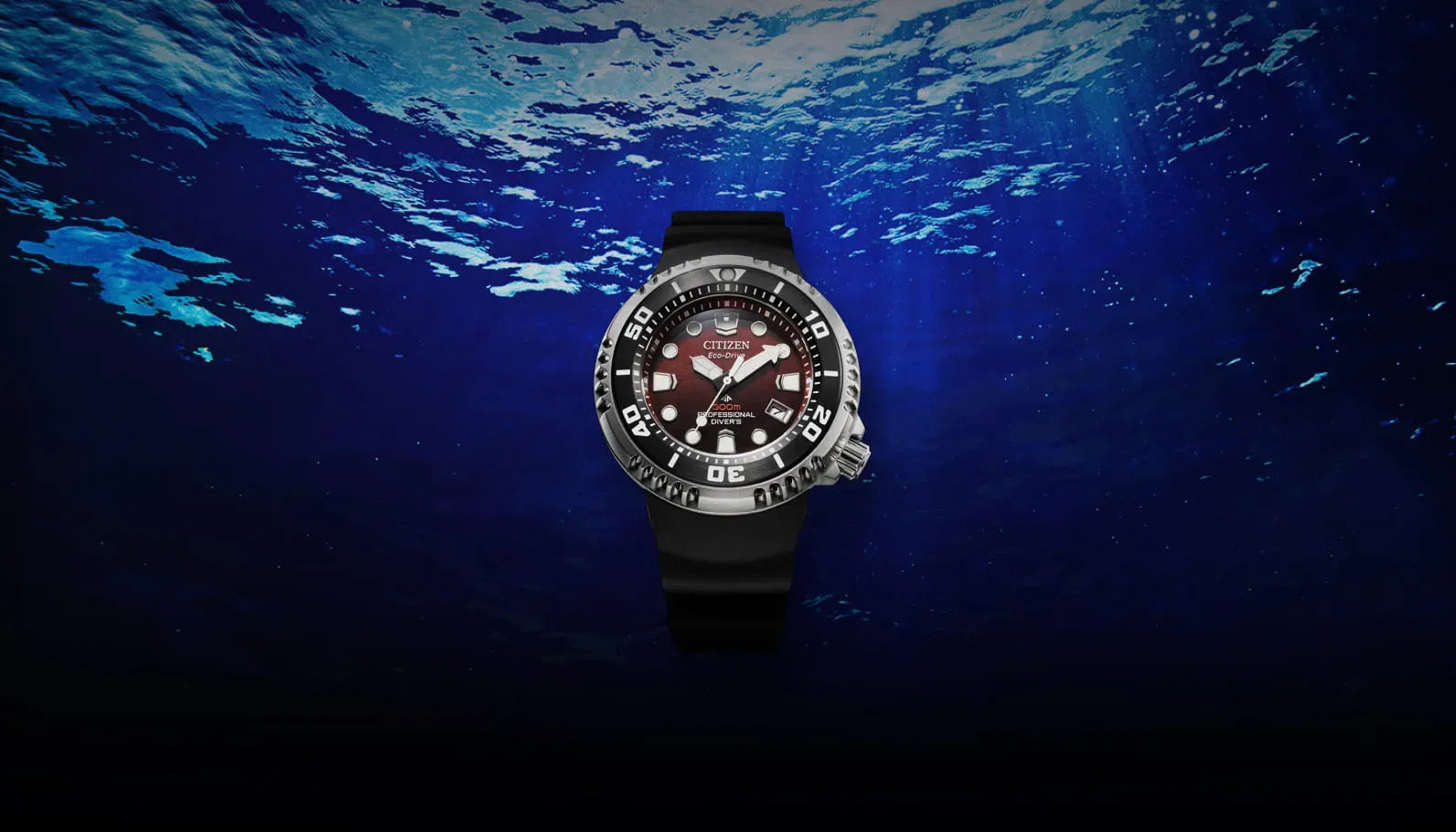
- What manufacturers say: 30m covers splashes and rain, 50m is rated for swimming, 100m adds snorkelling, and scuba needs a watch the maker rates for diving (usually marked "Diver's").
- What we recommend: for swimming, snorkelling or diving, choose at least 200m with a screw-down crown.
- Seals age. Have water resistance tested regularly and whenever the case is opened. Don't press buttons underwater, and keep watches out of spas and saunas.
The Watch Direct recommendation
Manufacturers rate 50m and 100m watches for swimming, and that's a fair technical reading of the charts. We still recommend a watch with at least 200m water resistance and a screw-down crown for swimming, snorkelling and diving. A screw-down crown threads onto the case, so it can't be pulled out or knocked open by accident. A higher rating also gives you more margin as gaskets age. And because water damage isn't covered under warranty, we'd rather you have that margin.
This is our recommendation, not an ISO rule. The international standards don't require a screw-down crown. Luminox takes a similar view, recommending 20 atm (200m) "with a crown with a rotating thread" for diving. Our warranty page says:
"*Please note that swimming with a watch is always a risk regardless of the water rating on the watch. Water damage is not covered under the warranty by WATCHDIRECT.COM.AU nor any manufacturer. We do not recommend swimming with your watch unless it has a 200m water rating and screw-in crown."From our Authenticity & Warranty page
In This Guide
- Why the numbers confuse people
- Every rating at a glance
- No rating or "water resistant" only
- 30m / 3 ATM
- 50m / 5 ATM
- 100m / 10 ATM
- 200m / 20 ATM and diver's watches
- 300m and beyond
- Why the crown matters
- ISO 22810 vs ISO 6425
- Keeping a watch water resistant
- Featured watches compared
- Frequently asked questions
Why the numbers confuse people
A "30m" or "100m" rating sounds like a depth you can safely reach. It isn't quite that. Under ISO 22810, the standard for everyday water-resistant watches, the number describes the pressure a watch is tested to in a laboratory. It tells you how well the case was sealed when it was made. It doesn't tell you how deep you can dive or which activities the watch is made for.
That's why most watchmakers publish a chart that translates the rating into everyday use. Those charts don't always agree: Seiko, Citizen and Casio say a 30m watch isn't for swimming, while Omega says its 30m watches can be worn for swimming. The safest approach is to follow the chart from the brand that made your watch.
The "dynamic pressure" myth
You may have read that jumping into a pool or swimming hard multiplies the pressure on a watch several times over. The physics doesn't support that. The Federation of the Swiss Watch Industry points out that to reach 2 bar of dynamic pressure you'd have to hit the water after a 20-metre jump, at about 70 km/h. Hodinkee calculated that even a very fast arm movement adds less than 2% to the pressure. The real risks are more mundane: ageing gaskets, a crown left pulled out, pressing buttons underwater, and heat.
Every rating at a glance
This summarises what manufacturers typically say each rating is made for. Charts vary between brands, so check yours. Tap a rating to jump to its section.
No rating, or "water resistant" with no depth
Some watches aren't water resistant at all, and many fashion and dress watches simply say "Water Resist" without a depth. Casio, for example, says a watch marked "Water Resistance" with no depth is "wearable while water is being splashed but not under any pressure". Treat these watches as rain-proof at best: take them off for washing up, showering and swimming, and dry them if they get wet.
30m / 3 ATM: splashes and rain
A 30m rating means the watch passed a 3 bar pressure test. Seiko's chart limits 3 bar watches to accidental splashes and rain, Citizen says they shouldn't be used where water pressure changes significantly, and Luminox lists 3 atm as "splash water". Many dress and fashion watches sit here. They're made for everyday wear on the wrist, not for the pool.

Rosefield · 30m / 3 ATM · Everyday dress watch
Rosefield Octagon XS OWGSG-O60
A small, octagonal dress watch rated to 3 ATM. That makes it fine in the rain or when you wash your hands, but it should come off before the pool, the beach or the shower.
- Water resistance: 3 ATM (30m)
- Crystal: Mineral
- Rated for: Splashes and rain (not swimming)
50m / 5 ATM: rated for swimming, not snorkelling
This is the rating the old advice most often gets wrong. Manufacturers do rate 50m watches for swimming: Seiko's chart includes swimming and taking a shower at 5 bar, Citizen says 5 bar is "for ordinary swimming", and Casio's 50m watches are made for use "during swimming". Snorkelling, diving and water sports are outside the rating. Timex and Casio both say 50m isn't for snorkelling.
The strap matters too. Leather doesn't like water, so even a 50m watch on leather is better kept dry.

Timex · 50m / 5 ATM · Retro everyday watch
Q Timex 1978 Red Vega Reissue TW2Y55700
Timex rates this 50m reissue as "suitable for light swimming" but "not suitable for snorkelling". It wears a leather strap, though, and leather and water don't mix, so we'd keep this one dry.
- Water resistance: 50m / 5 ATM
- Crystal: Domed acrylic
- Rated for: Light swimming (Timex); not snorkelling
100m / 10 ATM: swimming and snorkelling
At 100m, manufacturers add snorkelling and water sports. Casio lists "swimming, poolside diving, snorkeling", Timex says "swimming, snorkelling, poolside diving or surfing", and Victorinox says "swimming or snorkeling". None of them rate an ordinary 100m watch for scuba diving. That isn't because 100m is too shallow: ISO 6425 allows divers' watches from 100m. It's because scuba watches need diver-specific design and testing.
A 100m rating also doesn't tell you what kind of crown the watch has. Some 100m watches have a screw-down crown; many have a standard push-pull crown. The two watches below share the same rating but have different crowns.

Seiko · 100m / 10 bar · Push-pull crown
Seiko 5 Sports Field HDB009K
A 100m automatic field watch with a standard push-pull crown, not a screw-down crown. Seiko's chart rates 10 bar watches for swimming and shallow diving, but not for scuba.
- Water resistance: 100m / 10 bar
- Crown: Push-pull (not screw-down)
- Crystal: Curved Hardlex
- Rated for: Swimming and shallow diving; not scuba

Timex · 100m / 10 ATM · Screw-down crown
Timex 1995 Intrepid Reissue TW2Y05800
Also rated 100m, but Timex fits this one with a screw-down crown. Timex says it suits "swimming, snorkelling, poolside diving or surfing" but not scuba. The rating and the crown are separate specs, so check both.
- Water resistance: 100m / 10 ATM
- Crown: Screw-down (per Timex)
- Crystal: Mineral
- Rated for: Swimming, snorkelling, surfing; not scuba
Browse more: men's watches rated 100m or women's watches rated 100m.
200m / 20 ATM: our pick for swimming, and where most diver's watches sit
A 200m watch with a screw-down crown is what Watch Direct recommends for swimming, snorkelling and diving. It gives you a generous margin over the activity, and the crown can't be pulled out or knocked open by accident.
The rating alone doesn't make it a dive watch, though. Casio says its ordinary 200m watches can be worn "jet skiing, but not while scuba diving", and that only watches marked "DIVER'S WATCH 200M" can be worn for scuba. Seiko and Citizen draw the same line between ordinary 200m watches and diver's watches. Other brands, including Timex, Victorinox and Luminox, describe 200m as suitable for recreational scuba. For scuba, choose a watch the manufacturer specifically rates for diving.
200m with a screw-down crown

Timex · 200m / 20 ATM · Screw-down crown
Timex Deepwater Meridian 200 TW2W81900
Timex fits a screw-down crown and screw-on case back, a sapphire crystal and a one-way ratcheting top ring. It rates the watch for "swimming, snorkelling, surfing and recreational scuba-diving".
- Water resistance: 200m / 20 ATM
- Crown: Screw-down, with crown guard
- Crystal: Sapphire, anti-reflective
- Rated for: Swimming to recreational scuba (Timex)

Luminox · 200m / 20 ATM · Screw-down crown
Luminox Pacific Diver XS.3123.B
A 44mm Swiss quartz dive watch with 200m water resistance, a protected screw-down crown and a sapphire crystal. Luminox Light Technology keeps the hands and markers glowing without needing a charge from light.
- Water resistance: 200m / 20 ATM
- Crown: Screw-down, with crown protection
- Crystal: Sapphire, anti-reflective
- Bezel: One-way rotating
Diver's watches (rated for scuba)
Watches built to ISO 6425, the international standard for divers' watches, are usually marked "Diver's" followed by the depth. Most are rated 200m or more, with a one-way bezel to time your dive and strong lume for low light.

Seiko · Diver's 200m · Screw-down crown
Seiko Prospex PADI 60th Anniversary Diver's HBB002K
Marked "200m diver's" by Seiko, with a screw-down crown, a one-way ceramic bezel and a sapphire crystal. It's a limited edition of 8,000 pieces, so expect it to sell through.
- Water resistance: 200m diver's
- Crown: Screw-down
- Crystal: Sapphire
- Rated for: Scuba diving (Diver's rating)

Citizen · 200m scuba-rated · Screw-down crown
Citizen Promaster Dive Automatic NY0154-51L
Citizen describes this "Fugu" diver as "ISO compliant with a screw-down crown" and lists it as WR200M/20Bar for scuba diving. It has a sapphire crystal and a 44mm two-tone case.
- Water resistance: 200m / 20 bar (scuba)
- Crown: Screw-down (per Citizen)
- Crystal: Sapphire
- Standard: ISO compliant (per Citizen)
Browse more: all dive watches, men's watches rated 200m or women's watches rated 200m.
300m and beyond: deeper ratings and saturation diving
Ratings of 300m, 500m and 1000m are mostly about extra margin and robustness. Recreational scuba depths are well within the rating of a 200m diver's watch, so you don't need a deeper rating for holiday diving.
Saturation diving is a different world. Commercial saturation divers live for days or weeks in pressurised chambers, usually aboard a support ship, and travel to the work site in a diving bell. Helium from their breathing gas can slowly work its way into a watch case. As the chamber decompresses, that trapped gas can push the crystal off. There are two solutions: a helium escape valve, which lets the gas out, or a case sealed so helium can't get in. Seiko's chart reserves saturation diving for its Professional Diver's watches, and Citizen says its saturation-diving models "may include a helium gas escape valve". Swimmers and recreational divers don't need one.

Luminox · 300m / 30 ATM · Screw-down crown
Luminox MIL-SPEC Inspired 46mm XL.3351.2
Luminox describes this as a "Military Watch / Diver's Watch", rated to 300m, with a screw-down crown and a sapphire crystal. It's rated far deeper than any recreational dive needs.
- Water resistance: 300m / 30 ATM
- Crown: Screw-down
- Crystal: Sapphire, anti-reflective
Why the crown matters
The crown is the one part of the case you regularly pull out and turn. A standard push-pull crown relies on gaskets around the stem to keep water out. A screw-down crown threads onto a tube in the case and seals against it, so it can't be accidentally pulled into the setting position. Formex makes the same point: a screw-down crown "prevents the crown from accidentally popping out".
A screw-down crown only works when it's screwed down. Omega says, "If your watch is equipped with a screw-in crown, always screw it in", and Citizen warns against using a watch with a screw-lock crown while it's unlocked. Screw it down gently until it stops, without forcing it.
ISO 22810 vs ISO 6425
ISO 22810 covers everyday water-resistant watches. It sets out how a watch is tested to its marked pressure, and it has no minimum rating.
ISO 6425 covers divers' watches. According to published summaries of the 2018 edition, a divers' watch needs:
- at least 100m of water resistance
- a dive timer protected against accidental changes (usually a one-way rotating bezel, though a digital display is allowed)
- a dial readable in the dark from 25cm
- resistance to magnetism and shock
- a strap that passes a strength test
- water-resistance testing at 125% of the rated depth
ISO doesn't certify watches itself. Many brands test to the standard in-house and declare that a model complies, which is what a "Diver's" marking usually means. The standard doesn't require a screw-down crown or a helium escape valve.
Keeping a watch water resistant
Water resistance isn't permanent. Seiko says it "is not permanently guaranteed. It is affected by the ageing of gaskets", and Victorinox and Luminox say the same. These habits keep the seals doing their job:
- Test it regularly. Omega and Luminox suggest a check every year, Victorinox every 18 months, and Citizen recommends replacing gaskets every two to three years. Always have it tested when the case has been opened, including after a battery change.
- Don't press buttons or turn the crown underwater. Casio, Citizen, Omega, Timex, Luminox and Swatch all warn against it. Casio's Diver's 200M models are an exception.
- Keep screw-down crowns screwed down before your watch gets wet.
- Avoid heat. Citizen says not to wear a watch in hot water, a spa or a sauna, and Victorinox notes that temperatures above 60°C can affect the movement and battery.
- Rinse it with fresh water after the beach or the pool (Casio, Luminox and Victorinox all recommend it), and keep soap, sunscreen and solvents off the seals where you can.
- Choose the right strap. Steel, rubber or silicone suit water; leather doesn't.
- Watch for fogging. Brief misting after a sudden temperature change can be normal. If it doesn't clear within a few minutes, or you see droplets under the crystal, stop wearing it in water and have it checked. Luminox gives the same advice.
Is any watch "waterproof"?
Not officially. The Federation of the Swiss Watch Industry notes that markings such as "waterproof" don't correspond to any official standard, and watches are instead rated as water resistant to a tested pressure. You'll still see the word used as a search term, which is why our water-resistant watch collection uses that address. Use it to browse, then check each watch's rating and crown type against this guide.
Featured watches compared
Every watch in this guide, side by side. "Not stated" means the manufacturer doesn't list the crown type for that model.
Diver's 200m
Seiko Prospex PADI 60th Anniversary Diver's HBB002K
Crown: Screw-down · Crystal: Sapphire
| Watch | Rating | Crown | Crystal |
|---|---|---|---|
| Rosefield Octagon XS OWGSG-O60 | 30m / 3 ATM | Not stated | Mineral |
| Q Timex 1978 Red Vega Reissue TW2Y55700 | 50m / 5 ATM | Not stated | Domed acrylic |
| Seiko 5 Sports Field HDB009K | 100m / 10 bar | Push-pull | Curved Hardlex |
| Timex 1995 Intrepid Reissue TW2Y05800 | 100m / 10 ATM | Screw-down | Mineral |
| Timex Deepwater Meridian 200 TW2W81900 | 200m / 20 ATM | Screw-down | Sapphire |
| Luminox Pacific Diver XS.3123.B | 200m / 20 ATM | Screw-down | Sapphire |
| Seiko Prospex PADI 60th Anniversary Diver's HBB002K | Diver's 200m | Screw-down | Sapphire |
| Citizen Promaster Dive Automatic NY0154-51L | 200m (scuba) | Screw-down | Sapphire |
| Luminox MIL-SPEC Inspired 46mm XL.3351.2 | 300m / 30 ATM | Screw-down | Sapphire |
Shop by water resistance
- Dive watches →
- Men's 200m watches →
- Women's 200m watches →
- Men's 100m watches →
- Water-resistant watches →
Frequently asked questions
Can I swim with a 30m water-resistant watch?
Most manufacturers say no. Seiko, Citizen, Casio and Luminox rate 30m (3 ATM or 3 bar) for splashes and rain only. A few Swiss brands, such as Omega, allow swimming at 30m, so check your brand's chart. Either way, the watch won't simply flood at 30 metres; the number is a laboratory test pressure, not a dive depth.
Can I swim with a 50m or 100m watch?
Manufacturers rate 50m watches for swimming and 100m watches for swimming and snorkelling. Watch Direct is more cautious: we recommend a watch with at least 200m water resistance and a screw-down crown if you plan to swim, snorkel or dive with it, because gaskets age, crowns can be left open, and water damage isn't covered under warranty.
Can I wear my watch in the shower, spa or sauna?
Seiko and Victorinox rate 50m watches for showering, but heat is the bigger problem. Citizen says not to wear a watch in hot water, a hot spring (spa) or a sauna, and Casio says to avoid wearing it in the bath. Soaps and shampoos can also affect the gaskets, so we suggest taking it off.
Is every 200m watch a dive watch?
No. Casio, Seiko and Citizen only approve watches marked as diver's watches for scuba diving, even if an ordinary watch is also rated 200m. Most diver's watches are rated 200m or more, but ISO 6425, the international standard for divers' watches, starts at 100m. Look for a manufacturer's diving rating, usually marked "Diver's".
What is the difference between ISO 22810 and ISO 6425?
ISO 22810 covers everyday water-resistant watches and has no minimum rating. ISO 6425 covers divers' watches: at least 100m, a protected dive timer such as a one-way bezel, legibility in the dark, and tests for shock, magnetism, strap strength and water resistance at 125% of the rated depth. Neither standard requires a screw-down crown.
Do I need a helium escape valve?
Only for saturation diving, where professional divers live in pressurised chambers for days or weeks. Helium can seep into a watch, and a helium escape valve lets it out during decompression. Some brands use a helium-tight case instead. Recreational divers and swimmers don't need one.
How often should water resistance be tested?
Follow your brand's advice. Omega and Luminox suggest a check every year, Victorinox every 18 months, and Citizen recommends replacing gaskets every two to three years. Have it tested whenever the case is opened, including after a battery change.
Is any watch waterproof?
Not officially. The Federation of the Swiss Watch Industry notes that terms like "waterproof" don't correspond to any official standard. Watches are rated as water resistant to a tested pressure, which is why it's worth knowing what each rating means.
Authorised Retailer
Why buy your watch from Watch Direct?
We've been an authorised Australian watch retailer since 2011. Every watch comes with the manufacturer's warranty, free standard shipping Australia-wide and 30-day returns.
Shop Dive Watches → Shop Men's Watches → Shop Women's Watches →